
- Home
- Industries
- Aluminum Forging Industrial Hardware
- Impact Extrusion Tube
Impact Extrusion Tube
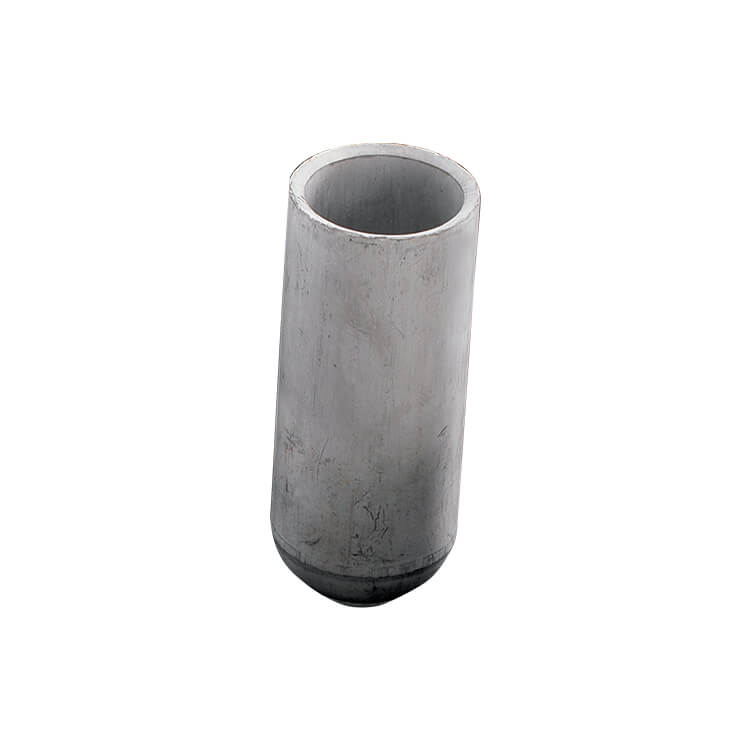
Aluminum Closed-End Impact Extrusion Tube: Wall and Rounded Base in One Stroke
The aluminum closed-end impact extrusion tube is a thin-walled tube with one open end and a rounded closed base. Al Forge Tech (AFT) forms the wall and base from a single aluminum slug by cold impact extrusion, so there is no weld or seam at the bottom. Cup-shaped tubes like this are used for housings that must contain pressure or seal, such as cylinder bodies, gas or fluid reservoirs, filter housings and shock absorber bodies.
When an end cap is welded onto tube stock, the area around the weld often becomes a leak path and a weak point. A one-piece closed-end tube avoids this, and the corner between wall and base keeps a continuous grain flow. After forming, AFT can turn the open end, machine threads or grooves and check for surface defects on its fluorescent penetrant inspection line, supplying housings ready for assembly.
Key Features
- Wall and rounded base formed in one piece with no weld or seam
- Continuous grain flow at the corner, suited to pressure housings
- Open end machinable for threads, grooves and sealing faces
- Fluorescent penetrant inspection for surface cracks and defects
Aluminum Closed-End Impact Extrusion Tube Specifications and Manufacturing Capability
| Item | Details |
|---|---|
| Product category | Aluminum Forging Industrial Hardware |
| Application | Cylinder bodies, gas/fluid reservoirs, filter housings, shock absorber bodies |
| Primary process | Cold impact extrusion (cold forging presses 260T–2,500T) |
| Material | Selected to customer specification; 2xxx, 5xxx, 6xxx and 7xxx series aluminum alloys available (e.g. 2014, 6061, 6082, 7075) |
| Heat treatment | In-house T4 solution treatment (8 units) and T6 artificial aging (7 units), set by alloy and strength requirement |
| Secondary machining | CNC machining (52 machining centers, 30 lathes), deburring, vibratory finishing |
| Surface finish | Anodizing (including hard anodizing), shot blasting, e-coating or painting, as required |
| Inspection | Zeiss CMM (4 units), hardness testers, spectrometer, fluorescent penetrant inspection line |
| Dimensions and tolerances | Per customer 2D/3D drawings |
| Quality system | IATF 16949:2016, ISO 14001:2015 |
Aluminum Closed-End Impact Extrusion Tube Manufacturing Process
- Drawing review and DFM: we confirm alloy, load direction and critical dimensions, then run QForm simulation to predict metal flow and defect risk.
- Die design and manufacturing: the number of die sets (for example, blocker and finisher dies) is planned around part complexity, and die contours are checked with a portable 3D scanner.
- Cold forging: impact extrusion on 260T–2,500T presses, suited to thin-walled, tubular and dimensionally repeatable parts.
- Heat treatment: T4 solution treatment and T6 artificial aging are performed in-house, with parameters set by alloy and strength requirement.
- CNC machining and finishing: holes, threads and mating surfaces are machined, followed by deburring, vibratory finishing, shot blasting or anodizing as required.
- Inspection and shipment: dimensions, hardness and chemical composition are verified with CMM, hardness testers and a spectrometer, with lot traceability kept under IATF 16949.
FAQ
Why is a closed-end tube better than a tube with a welded end cap for pressure housings?
A welded end cap leaves a weld bead and heat-affected zone whose strength and density are usually lower than the base metal, and which is a common starting point for leaks. In an impact extruded closed-end tube, base and wall come from the same piece of material with no seam, so stress under internal pressure is distributed more continuously. Actual pressure capability must still be validated for the alloy, wall thickness and design conditions.
What secondary machining can be done on the open end?
Typical operations include facing the open end, finishing the bore and OD, internal or external threads, O-ring grooves and chamfers. AFT performs impact extrusion, heat treatment and turning in one facility, with anodizing available, which removes inter-plant steps. Please specify sealing-surface roughness and thread standards on the drawing so machining and inspection can be planned.
How does a forged aluminum Aluminum Closed-End Impact Extrusion Tube compare with casting or machining from billet?
Forging shapes aluminum in the solid state under pressure, so the grain flow follows the part contour and the porosity and shrinkage common in castings are avoided. Compared with machining from solid billet, a near-net-shape forging removes less material and shortens machining time. For a Aluminum Closed-End Impact Extrusion Tube under repeated loads, forging balances strength and weight; the final choice still depends on design loads and volume.
What information do you need to quote the Aluminum Closed-End Impact Extrusion Tube?
Please send a 3D model and 2D drawing, alloy grade and temper, critical tolerances, surface finish requirements, estimated annual volume and target delivery date. Complete data lets our engineers judge forging feasibility, the number of die sets and the machining scope for the Aluminum Closed-End Impact Extrusion Tube at the quotation stage. If the design is still conceptual, a sketch is enough to start a DFM discussion.
Can the Aluminum Closed-End Impact Extrusion Tube be anodized or given other surface finishes?
Yes. Al Forge Tech offers anodizing (including hard anodizing), shot blasting, vibratory finishing, e-coating and painting, plus pickling and ultrasonic washing lines to clean parts after machining. Please note the finish type and film thickness on the drawing so machining allowances and cosmetic standards for the Aluminum Closed-End Impact Extrusion Tube can be evaluated together.
Request a Quote for the Aluminum Closed-End Impact Extrusion Tube
Developing a new Aluminum Closed-End Impact Extrusion Tube or converting an existing part to aluminum forging? Send us your 3D/2D drawings, alloy and temper, annual volume and finishing requirements. Our engineering team will reply with a feasibility review, die plan and quotation.
- Online inquiry: Contact Us
- Email: aft@aft-forge.com.tw
To compare similar parts, browse Aluminum Forging Industrial Hardware and our industrial hardware forging applications, or visit About Us for our equipment and certifications.