
- Home
- Industries
- Aluminum Forging Moto Parts
- Transmission Casing
Transmission Casing
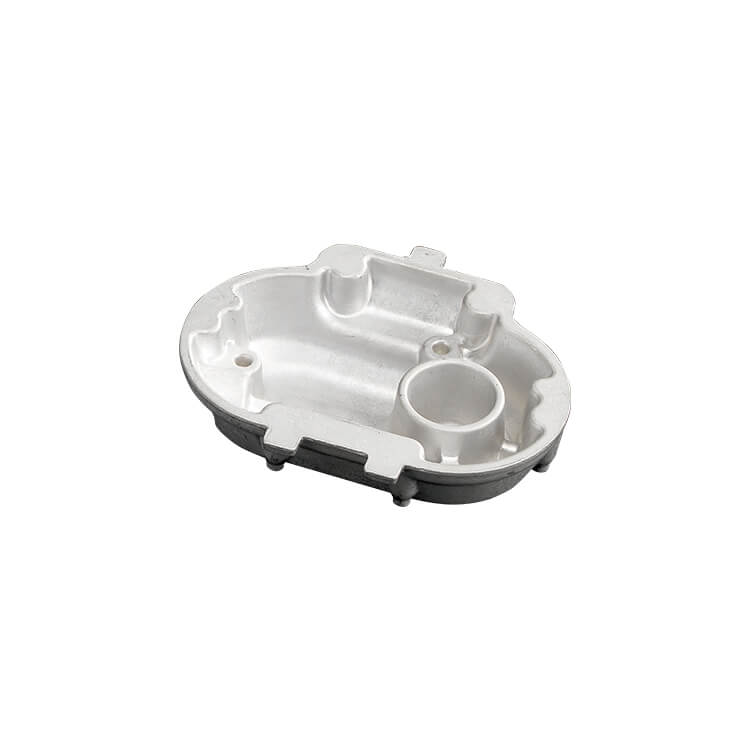
Forged Aluminum Transmission Casing: Heavy-Motorcycle Drivetrain Housing
The forged aluminum transmission casing is a housing forging for a heavy-motorcycle drivetrain. It is an oval shallow shell with a round bearing-seat boss, a square mounting boss and several bolt bosses inside, and a sealing flange around the rim that mates with the engine case. The casing supports bearings, holds gear positions and protects internal mechanisms.
A forged casing is denser than a cast one, so bearing seats and sealing faces are less prone to porosity and oil seepage after machining, and walls can be thinner for the same stiffness. Al Forge Tech (AFT) closed-die hot forges the shell and internal bosses, applies in-house T6 heat treatment, machines bearing bores, sealing faces and bolt holes on 4.5-axis CNC, and verifies bearing-bore position and sealing-face flatness on CMM.
Key Features
- Shallow shell, internal bearing seat and mounting bosses forged in one piece
- Dense structure resists oil seepage after sealing-face machining
- Bearing bores and sealing faces on 4.5-axis CNC
- Bearing-bore position and sealing-face flatness measured on CMM
Forged Aluminum Transmission Casing Specifications and Manufacturing Capability
| Item | Details |
|---|---|
| Product category | Aluminum Forging Moto Parts |
| Application | Transmission and drivetrain housings for heavy motorcycles and motorcycles |
| Primary process | Closed-die hot forging (hot forging presses 600T–8,000T) |
| Material | Per customer specification; heavy-motorcycle parts produced in grades such as 6061-T6, 2014-T6 and 7075-T6 |
| Heat treatment | In-house T4 solution treatment (8 units) and T6 artificial aging (7 units), set by alloy and strength requirement |
| Secondary machining | CNC machining (52 machining centers, 30 lathes), deburring, vibratory finishing |
| Surface finish | Anodizing (including hard anodizing), shot blasting, e-coating or painting, as required |
| Inspection | Zeiss CMM (4 units), hardness testers, spectrometer, fluorescent penetrant inspection line |
| Dimensions and tolerances | Per customer 2D/3D drawings |
| Quality system | IATF 16949:2016, ISO 14001:2015 |
Forged Aluminum Transmission Casing Manufacturing Process
- Drawing review and DFM: we confirm alloy, load direction and critical dimensions, then run QForm simulation to predict metal flow and defect risk.
- Die design and manufacturing: the number of die sets (for example, blocker and finisher dies) is planned around part complexity, and die contours are checked with a portable 3D scanner.
- Hot forging: closed-die forming on 600T–8,000T hot forging presses creates a continuous grain flow that follows the part contour.
- Heat treatment: T4 solution treatment and T6 artificial aging are performed in-house, with parameters set by alloy and strength requirement.
- CNC machining and finishing: holes, threads and mating surfaces are machined, followed by deburring, vibratory finishing, shot blasting or anodizing as required.
- Inspection and shipment: dimensions, hardness and chemical composition are verified with CMM, hardness testers and a spectrometer, with lot traceability kept under IATF 16949.
FAQ
Why forge a transmission casing rather than cast it?
Casting can create complex internal cavities, but internal porosity may be exposed when bearing seats and sealing faces are machined, causing oil seepage or reduced strength. A forged casing is denser and stronger, allowing thinner walls for the same stiffness and lower weight. For housings that are mainly shallow shells with bosses, forging balances quality and weight; very deep or highly complex cavities need case-by-case evaluation.
How is sealing-face flatness ensured?
Sealing-face flatness determines whether the joint to the engine case seeps oil. AFT machines the sealing face only after T6 heat treatment so heat-treatment distortion does not affect final flatness, supports the casing with dedicated fixtures to limit machining distortion, and measures flatness and bearing-bore position on Zeiss CMM with records retained.
Is heat treatment for the Forged Aluminum Transmission Casing done in-house?
Yes. Al Forge Tech operates 8 T4 solution treatment units and 7 T6 artificial aging units on site, so the Forged Aluminum Transmission Casing can be solution treated, quenched and aged in the same facility before machining and inspection. Keeping heat treatment in-house removes inter-plant transport, reduces lead-time risk and keeps lot traceability within one quality system. Parameters are set according to the alloy grade and your specification.
Can you assess forging feasibility while the Forged Aluminum Transmission Casing is still in design?
Yes. Al Forge Tech works mainly as an OEM supplier, and our engineers can give design-for-manufacturability (DFM) feedback at the concept or drawing stage, such as adjusting thin ribs, abrupt section changes or draft angles to avoid laps and underfill. QForm simulation predicts metal flow early, and the results are cross-checked against our die design experience.
Can Al Forge Tech supply the Forged Aluminum Transmission Casing from forging through machining?
Yes. Forging, heat treatment, CNC machining, surface finishing and inspection are integrated in one facility: 52 CNC machining centers (40 four-axis and 12 4.5-axis), 30 lathes (14 with robotic loading), plus broaching, burnishing and centerless grinding. The Forged Aluminum Transmission Casing can be delivered as a forged blank, semi-finished or fully machined part.
Request a Quote for the Forged Aluminum Transmission Casing
Developing a new Forged Aluminum Transmission Casing or converting an existing part to aluminum forging? Send us your 3D/2D drawings, alloy and temper, annual volume and finishing requirements. Our engineering team will reply with a feasibility review, die plan and quotation.
- Online inquiry: Contact Us
- Email: aft@aft-forge.com.tw
To compare similar parts, browse Aluminum Forging Moto Parts and our motorcycle aluminum forging applications, or visit About Us for our equipment and certifications.