
- Home
- Industries
- Aluminum Forging Automobile Parts
- Brake Caliper
Brake Caliper
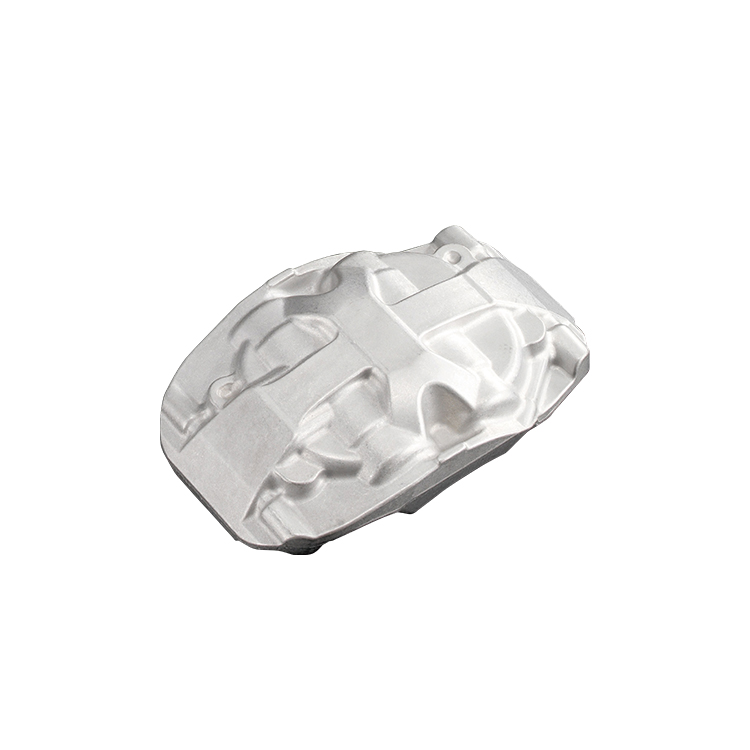
Forged Aluminum Automotive Brake Caliper: Monobloc Caliper Forging
The forged aluminum automotive brake caliper is a monobloc forging for an opposed-piston brake caliper. A bridge-shaped body spans the brake disc, with piston bores on both sides and reinforcing ribs and lightening pockets on its surface. A monobloc caliper has no bolted joint between halves, so it is stiffer and deflects less under braking, which is why it is common on performance cars and aftermarket brake systems.
With its three-dimensional shape and many pockets, a monobloc caliper cannot be formed in one hit in the solid state as a casting would be. Al Forge Tech (AFT) typically plans several forging stages and multiple die sets (for example, three sets) to form the part progressively and avoid laps and underfill. After in-house T6 heat treatment, piston bores, fluid passages and mounting holes are machined on 4.5-axis CNC, with CMM and fluorescent penetrant inspection.
Key Features
- Monobloc bridge body for high stiffness and low deflection under braking
- Formed progressively over multiple forging stages and die sets
- Piston bores, fluid passages and mounting holes on 4.5-axis CNC
- Fluorescent penetrant, CMM and hardness inspection
Forged Aluminum Automotive Brake Caliper Specifications and Manufacturing Capability
| Item | Details |
|---|---|
| Product category | Aluminum Forging Automobile Parts |
| Application | Opposed-piston brake systems for performance and modified cars |
| Primary process | Closed-die hot forging (hot forging presses 600T–8,000T) |
| Material | Per customer specification; 6xxx alloys common for chassis and suspension parts (e.g. 6061, 6082, 6110), 7xxx evaluated for higher strength |
| Heat treatment | In-house T4 solution treatment (8 units) and T6 artificial aging (7 units), set by alloy and strength requirement |
| Secondary machining | CNC machining (52 machining centers, 30 lathes), deburring, vibratory finishing |
| Surface finish | Anodizing (including hard anodizing), shot blasting, e-coating or painting, as required |
| Inspection | Zeiss CMM (4 units), hardness testers, spectrometer, fluorescent penetrant line; tensile and fatigue testing available |
| Dimensions and tolerances | Per customer 2D/3D drawings |
| Quality system | IATF 16949:2016, ISO 14001:2015 |
Forged Aluminum Automotive Brake Caliper Manufacturing Process
- Drawing review and DFM: we confirm alloy, load direction and critical dimensions, then run QForm simulation to predict metal flow and defect risk.
- Die design and manufacturing: the number of die sets (for example, blocker and finisher dies) is planned around part complexity, and die contours are checked with a portable 3D scanner.
- Hot forging: closed-die forming on 600T–8,000T hot forging presses creates a continuous grain flow that follows the part contour.
- Heat treatment: T4 solution treatment and T6 artificial aging are performed in-house, with parameters set by alloy and strength requirement.
- CNC machining and finishing: holes, threads and mating surfaces are machined, followed by deburring, vibratory finishing, shot blasting or anodizing as required.
- Inspection and shipment: dimensions, hardness and chemical composition are verified with CMM, hardness testers and a spectrometer, with lot traceability kept under IATF 16949.
FAQ
Why does a monobloc brake caliper need multiple die sets?
The bridge body, piston bore bosses and lightening pockets of a monobloc caliper are complex, and solid metal can only flow a limited distance in the die. Forming it in one hit risks laps at pocket corners or underfill at the bore bosses. It is therefore formed progressively with blocker, intermediate and finisher dies, for example three die sets, so material is placed correctly before details are formed.
How does a monobloc caliper differ from a two-piece caliper?
A two-piece caliper bolts left and right halves together, which is easier to machine, but the joint can deflect slightly under high load. A monobloc caliper is machined from a single forging, giving a stiffer body, less deflection under braking and a more direct pedal feel, at the cost of more demanding forging and machining. AFT has production experience with forged calipers for two-, three- and four-wheeled vehicles.
Is heat treatment for the Forged Aluminum Automotive Brake Caliper done in-house?
Yes. Al Forge Tech operates 8 T4 solution treatment units and 7 T6 artificial aging units on site, so the Forged Aluminum Automotive Brake Caliper can be solution treated, quenched and aged in the same facility before machining and inspection. Keeping heat treatment in-house removes inter-plant transport, reduces lead-time risk and keeps lot traceability within one quality system. Parameters are set according to the alloy grade and your specification.
How do you keep the Forged Aluminum Automotive Brake Caliper consistent from lot to lot?
Al Forge Tech runs incoming (IQC), in-process (IPQC) and final (FQC) inspection under IATF 16949:2016, supported by 4 Zeiss CMMs, hardness testers, a spectrometer and a fluorescent penetrant inspection line. First, middle and last pieces of every lot are checked against the die; when wear causes dimensional drift, the die is reworked to keep the Forged Aluminum Automotive Brake Caliper stable across lots.
Can Al Forge Tech supply the Forged Aluminum Automotive Brake Caliper from forging through machining?
Yes. Forging, heat treatment, CNC machining, surface finishing and inspection are integrated in one facility: 52 CNC machining centers (40 four-axis and 12 4.5-axis), 30 lathes (14 with robotic loading), plus broaching, burnishing and centerless grinding. The Forged Aluminum Automotive Brake Caliper can be delivered as a forged blank, semi-finished or fully machined part.
Request a Quote for the Forged Aluminum Automotive Brake Caliper
Developing a new Forged Aluminum Automotive Brake Caliper or converting an existing part to aluminum forging? Send us your 3D/2D drawings, alloy and temper, annual volume and finishing requirements. Our engineering team will reply with a feasibility review, die plan and quotation.
- Online inquiry: Contact Us
- Email: aft@aft-forge.com.tw
To compare similar parts, browse Aluminum Forging Automobile Parts and our automotive aluminum forging applications, or visit About Us for our equipment and certifications.