
- Home
- Industries
- Aluminum Forging Automobile Parts
- Control Arm
Control Arm
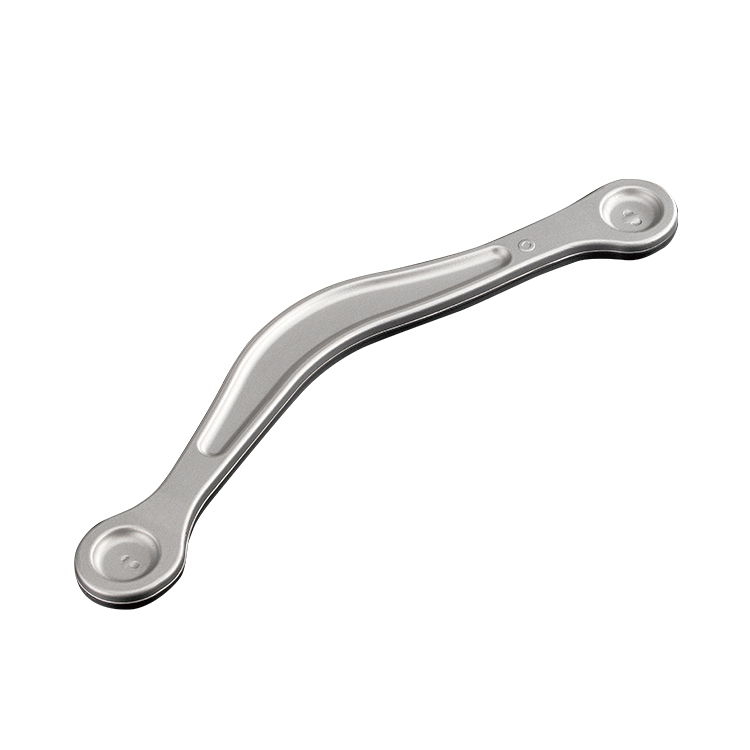
Forged Aluminum Automotive Link Control Arm: Curved Suspension Link with Twin Bushing Eyes
The forged aluminum automotive link control arm is a link in a multi-link suspension. It has a curved slender body with a round bushing eye at each end and an I-beam cross-section, whose central channel saves weight while keeping the upper and lower flanges stiff. In a multi-link suspension, several links locate the wheel together, each carrying tension and compression in a defined direction.
An I-section gives high bending stiffness with little material. Al Forge Tech (AFT) closed-die hot forges the flanges and channel directly so grain flow runs continuously along the curved body into both bushing eyes. AFT manages automotive parts under IATF 16949:2016; after in-house T6 heat treatment, both bushing bores are CNC-machined and their center distance and parallelism verified on CMM.
Key Features
- Curved I-section body balances light weight and bending stiffness
- Continuous grain flow from body into both bushing eyes
- Bushing bore center distance and parallelism CNC-machined and CMM-checked
- Automotive production managed under IATF 16949:2016
Forged Aluminum Automotive Link Control Arm Specifications and Manufacturing Capability
| Item | Details |
|---|---|
| Product category | Aluminum Forging Automobile Parts |
| Application | Automotive multi-link rear suspension and front suspension links |
| Primary process | Closed-die hot forging (hot forging presses 600T–8,000T) |
| Material | Per customer specification; 6xxx alloys common for chassis and suspension parts (e.g. 6061, 6082, 6110), 7xxx evaluated for higher strength |
| Heat treatment | In-house T4 solution treatment (8 units) and T6 artificial aging (7 units), set by alloy and strength requirement |
| Secondary machining | CNC machining (52 machining centers, 30 lathes), deburring, vibratory finishing |
| Surface finish | Anodizing (including hard anodizing), shot blasting, e-coating or painting, as required |
| Inspection | Zeiss CMM (4 units), hardness testers, spectrometer, fluorescent penetrant line; tensile and fatigue testing available |
| Dimensions and tolerances | Per customer 2D/3D drawings |
| Quality system | IATF 16949:2016, ISO 14001:2015 |
Forged Aluminum Automotive Link Control Arm Manufacturing Process
- Drawing review and DFM: we confirm alloy, load direction and critical dimensions, then run QForm simulation to predict metal flow and defect risk.
- Die design and manufacturing: the number of die sets (for example, blocker and finisher dies) is planned around part complexity, and die contours are checked with a portable 3D scanner.
- Hot forging: closed-die forming on 600T–8,000T hot forging presses creates a continuous grain flow that follows the part contour.
- Heat treatment: T4 solution treatment and T6 artificial aging are performed in-house, with parameters set by alloy and strength requirement.
- CNC machining and finishing: holes, threads and mating surfaces are machined, followed by deburring, vibratory finishing, shot blasting or anodizing as required.
- Inspection and shipment: dimensions, hardness and chemical composition are verified with CMM, hardness testers and a spectrometer, with lot traceability kept under IATF 16949.
FAQ
What does an I-section offer an automotive control arm?
An I-section concentrates material in the upper and lower flanges joined by a thinner web, giving higher bending stiffness for the same weight, while the central channel removes unnecessary material. Forging the I-section keeps grain flow continuous between flanges and web, which is more efficient than machining and denser than casting.
How are center distance and parallelism of the two bushing bores ensured?
The center distance and parallelism of the bushing bores affect suspension geometry and wheel alignment. After T6 heat treatment, AFT machines both bores in a single CNC setup so they share one datum, then measures center distance, diameter and parallelism on Zeiss CMM, keeping records under IATF 16949 for traceability.
How does a forged aluminum Forged Aluminum Automotive Link Control Arm compare with casting or machining from billet?
Forging shapes aluminum in the solid state under pressure, so the grain flow follows the part contour and the porosity and shrinkage common in castings are avoided. Compared with machining from solid billet, a near-net-shape forging removes less material and shortens machining time. For a Forged Aluminum Automotive Link Control Arm under repeated loads, forging balances strength and weight; the final choice still depends on design loads and volume.
How do you keep the Forged Aluminum Automotive Link Control Arm consistent from lot to lot?
Al Forge Tech runs incoming (IQC), in-process (IPQC) and final (FQC) inspection under IATF 16949:2016, supported by 4 Zeiss CMMs, hardness testers, a spectrometer and a fluorescent penetrant inspection line. First, middle and last pieces of every lot are checked against the die; when wear causes dimensional drift, the die is reworked to keep the Forged Aluminum Automotive Link Control Arm stable across lots.
Is heat treatment for the Forged Aluminum Automotive Link Control Arm done in-house?
Yes. Al Forge Tech operates 8 T4 solution treatment units and 7 T6 artificial aging units on site, so the Forged Aluminum Automotive Link Control Arm can be solution treated, quenched and aged in the same facility before machining and inspection. Keeping heat treatment in-house removes inter-plant transport, reduces lead-time risk and keeps lot traceability within one quality system. Parameters are set according to the alloy grade and your specification.
Request a Quote for the Forged Aluminum Automotive Link Control Arm
Developing a new Forged Aluminum Automotive Link Control Arm or converting an existing part to aluminum forging? Send us your 3D/2D drawings, alloy and temper, annual volume and finishing requirements. Our engineering team will reply with a feasibility review, die plan and quotation.
- Online inquiry: Contact Us
- Email: aft@aft-forge.com.tw
To compare similar parts, browse Aluminum Forging Automobile Parts and our automotive aluminum forging applications, or visit About Us for our equipment and certifications.