
Stem
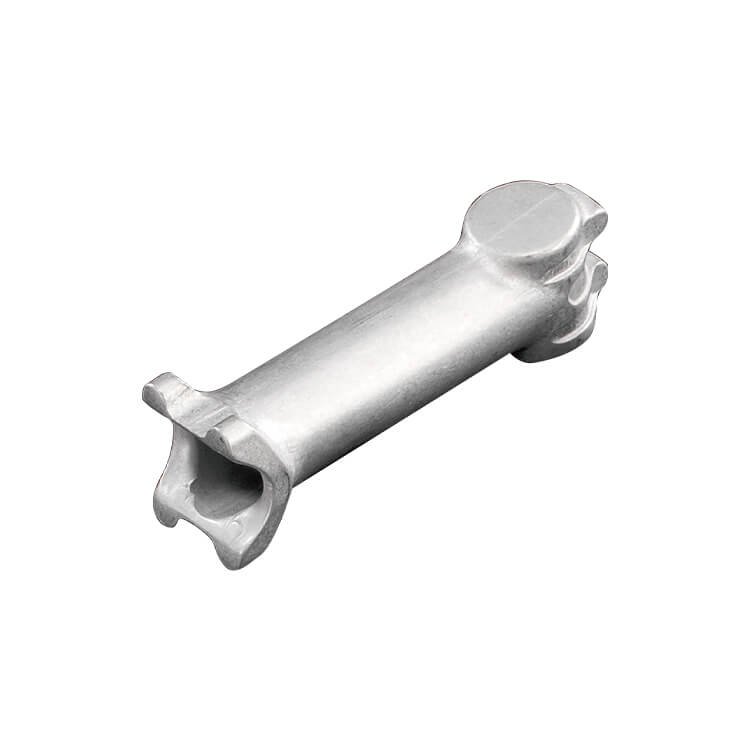
Forged Aluminum 3D Bicycle Stem: Long-Reach Handlebar Stem
The forged aluminum 3D bicycle stem connects the handlebar to the fork steerer tube. This long-reach version has a four-bolt handlebar clamp at one end, a steerer clamp cylinder at the other, and a hollow-section body between them. Stem length affects riding position and steering response, and long-reach stems are common on road and cross-country mountain bikes.
The stem carries bending and torsional loads from the handlebar and is a safety-critical bicycle part. Al Forge Tech (AFT) 3D hot forges the handlebar clamp, body and steerer clamp in one operation so grain flow runs continuously to both ends, with lightening pockets formed during forging. After heat treatment, clamp bores, slots and threads are CNC-machined, and the angle between the two bores is verified on CMM.
Key Features
- 3D forged handlebar clamp, body and steerer clamp in one operation
- Long-reach design for road and mountain bikes
- Clamp bores, slots and threads CNC-machined
- Bore angle and diameter verified on CMM
Forged Aluminum 3D Bicycle Stem Specifications and Manufacturing Capability
| Item | Details |
|---|---|
| Product category | Aluminum Forging Bicycle Parts |
| Application | Stems for road bikes, mountain bikes and e-bikes |
| Primary process | Closed-die hot forging (hot forging presses 600T–8,000T) |
| Material | Selected to customer specification; 2xxx, 5xxx, 6xxx and 7xxx series aluminum alloys available (e.g. 2014, 6061, 6082, 7075) |
| Heat treatment | In-house T4 solution treatment (8 units) and T6 artificial aging (7 units), set by alloy and strength requirement |
| Secondary machining | CNC machining (52 machining centers, 30 lathes), deburring, vibratory finishing |
| Surface finish | Anodizing (including hard anodizing), shot blasting, e-coating or painting, as required |
| Inspection | Zeiss CMM (4 units), hardness testers, spectrometer, fluorescent penetrant inspection line |
| Dimensions and tolerances | Per customer 2D/3D drawings |
| Quality system | IATF 16949:2016, ISO 14001:2015 |
Forged Aluminum 3D Bicycle Stem Manufacturing Process
- Drawing review and DFM: we confirm alloy, load direction and critical dimensions, then run QForm simulation to predict metal flow and defect risk.
- Die design and manufacturing: the number of die sets (for example, blocker and finisher dies) is planned around part complexity, and die contours are checked with a portable 3D scanner.
- Hot forging: closed-die forming on 600T–8,000T hot forging presses creates a continuous grain flow that follows the part contour.
- Heat treatment: T4 solution treatment and T6 artificial aging are performed in-house, with parameters set by alloy and strength requirement.
- CNC machining and finishing: holes, threads and mating surfaces are machined, followed by deburring, vibratory finishing, shot blasting or anodizing as required.
- Inspection and shipment: dimensions, hardness and chemical composition are verified with CMM, hardness testers and a spectrometer, with lot traceability kept under IATF 16949.
FAQ
How does a 3D forged stem differ from an extruded and machined stem?
An extruded-and-machined stem is cut from an extrusion, so its body section is limited by the extrusion direction and lightening is usually done by drilling or milling. A 3D forged stem is formed in several directions at once, so body sections and lightening pockets can follow the loads and grain flow follows the contour. For a stem under bending and torsion, 3D forging reaches the required strength with a more rational material distribution.
How do long and short stems differ in manufacturing?
A long stem has a longer body, so material must be distributed evenly along its length during forging and bending distortion must be controlled after heat treatment. A short stem is compact, with material concentrated in the two clamps. AFT plans dies by stem length, angle and handlebar clamp style, and checks the angle between bores after heat treatment.
How does a forged aluminum Forged Aluminum 3D Bicycle Stem compare with casting or machining from billet?
Forging shapes aluminum in the solid state under pressure, so the grain flow follows the part contour and the porosity and shrinkage common in castings are avoided. Compared with machining from solid billet, a near-net-shape forging removes less material and shortens machining time. For a Forged Aluminum 3D Bicycle Stem under repeated loads, forging balances strength and weight; the final choice still depends on design loads and volume.
How do you keep the Forged Aluminum 3D Bicycle Stem consistent from lot to lot?
Al Forge Tech runs incoming (IQC), in-process (IPQC) and final (FQC) inspection under IATF 16949:2016, supported by 4 Zeiss CMMs, hardness testers, a spectrometer and a fluorescent penetrant inspection line. First, middle and last pieces of every lot are checked against the die; when wear causes dimensional drift, the die is reworked to keep the Forged Aluminum 3D Bicycle Stem stable across lots.
How are MOQ and lead time for the Forged Aluminum 3D Bicycle Stem determined?
MOQ and lead time depend on part size, number of die sets, alloy and machining scope, and are confirmed in the quotation after drawing review. The typical sequence is die development, forged samples, sample approval and then mass production. Sharing your annual volume and call-off schedule helps us plan dies and capacity for the Forged Aluminum 3D Bicycle Stem.
Request a Quote for the Forged Aluminum 3D Bicycle Stem
Developing a new Forged Aluminum 3D Bicycle Stem or converting an existing part to aluminum forging? Send us your 3D/2D drawings, alloy and temper, annual volume and finishing requirements. Our engineering team will reply with a feasibility review, die plan and quotation.
- Online inquiry: Contact Us
- Email: aft@aft-forge.com.tw
To compare similar parts, browse Aluminum Forging Bicycle Parts and our bicycle aluminum forging applications, or visit About Us for our equipment and certifications.